Series cover. This is an original explanatory graphic, not an experimental photograph.
Series 02 — the arbitrary-input case
This article discusses Q. Hu et al., “Arbitrary vectorial state conversion using liquid crystal spatial light modulators,” published in Optics Communications in 2020.
The first article started from a fixed input polarization. Two independent retardances generated the desired output polarization, and a third phase-only interaction prescribed the common spatial phase.
That reasoning no longer works when the input polarization is arbitrary. The nominally “phase-only” interaction may modulate only one projection of the field and can therefore change the polarization as well. Hu et al. analyze this coupling and show why a fourth, orthogonal SLM interaction restores universal phase coverage in their ideal model.
The result in one paragraph
A three-interaction sequence with axes (0°), (45°), and (0°) can connect any input polarization point to any output polarization point on the Poincaré sphere. It is nevertheless not a universal vectorial-state converter because the allowed retardances may not cover an arbitrary common output phase after the endpoint polarization is fixed. Adding a fourth interaction with an axis orthogonal to the first—giving (0°), (90°), (45°), (0°)—provides complementary phase control. The 2020 paper establishes this result through an ideal model, geometric reasoning, and numerical tests; it does not report a four-SLM experimental apparatus.
1. What system did the paper actually study?
Figure 1 of the 2020 paper is an idealized sequence of liquid-crystal SLM interactions, not a photograph or a complete specification of a constructed four-SLM experiment.
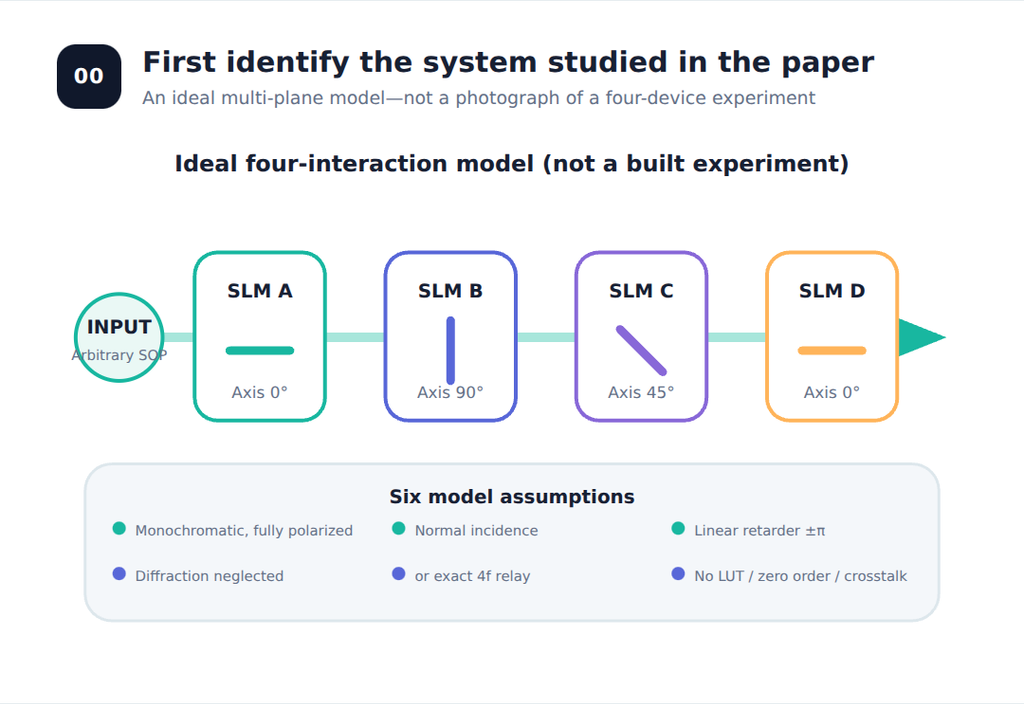
Figure 1. Ideal-model sequence. The diagram must not be described as a four-SLM apparatus constructed by the authors.
The model assumes:
- monochromatic, collimated, fully polarized input light;
- spatially varying input polarization and phase are allowed;
- each SLM pixel behaves as a lossless fixed-axis linear retarder;
- the programmable relative retardance spans ;
- normal incidence and negligible diffraction between adjacent modulation planes;
- a 4f relay may be inserted when two planes cannot be placed sufficiently close together;
- a spatially uniform phase offset common to the full beam is ignored.
The model does not include grayscale-to-retardance lookup tables, zero-order leakage, pixel crosstalk, diattenuation, loss, finite diffraction efficiency, registration error, or drift.
The paper draws rotatable transmissive SLMs for analytical clarity. A practical system would more commonly use reflective LCoS devices, multiple illuminated regions of one device, folding mirrors, wave plates, and 4f relays. Those implementation choices are engineering extensions unless explicitly demonstrated.
2. The Jones model for one interaction
For an SLM active axis at and a programmable delay , the ideal Jones matrix is
Only the field component parallel to the active axis receives the programmed phase. The orthogonal component is unchanged in this ideal convention.
Three limiting cases clarify the behavior:
| Input relative to the active axis | Result of changing |
|---|---|
| Parallel | The polarization is unchanged and the selected component receives the full programmable phase |
| Orthogonal | The programmed delay has no effect on the field |
| Between the axes | Polarization and projected phase change together |
This is why an SLM interaction cannot generally be classified as “polarization-only” or “phase-only” without specifying the incident polarization at that interaction.
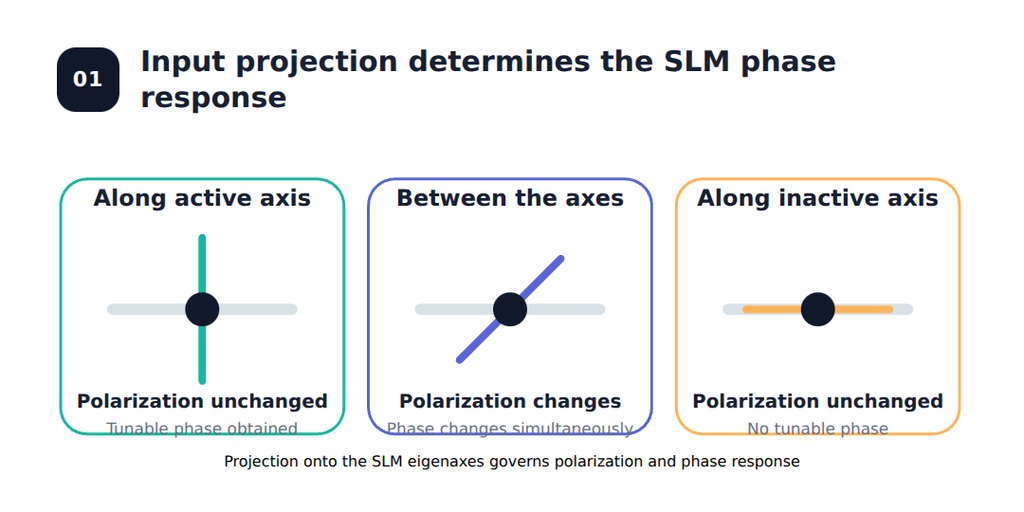
Figure 2. The incident projection determines whether a programmed delay acts mainly as phase control, polarization control, or has no effect.
3. What the Poincaré sphere retains—and what it removes
For a normalized Jones vector , this series uses
A linear retarder rotates about an equatorial axis. A cascade of SLM interactions therefore becomes a sequence of rotations on the sphere.
The sphere records the output polarization but removes a common factor multiplying the Jones vector. Two fields can occupy the same point on the sphere while differing by a measurable phase relative to an external reference.
This omission is not a flaw. It is the reason polarization reachability and full vectorial-state reachability must be tested separately.
4. What three interactions can already do
The analyzed three-interaction sequence is
On the Poincaré sphere, this is a sequence of rotations about two orthogonal equatorial axes. Such a sequence can connect an arbitrary input polarization point to an arbitrary output polarization point.
Therefore, three interactions are sufficient when the only requirement is the final polarization.
They are not automatically sufficient when the output Jones vector must also have a specified common phase. Once the input and output polarization states are fixed, the three retardances are coupled by the endpoint constraint. Counting three adjustable numbers for three desired quantities gives a necessary degree-of-freedom count, not a proof of global reachability.
5. A counterexample that exposes the phase blind spot
Let the input and target polarization both be vertical, but require a relative output phase of :
In the (0°)–(45°)–(0°) sequence, the first and third interactions leave the vertical component on their unmodulated eigenaxis. The middle 45° retardance must also satisfy the requirement that the final polarization return to vertical. The sequence therefore cannot freely add the requested phase while preserving the endpoint polarization.
The input and target occupy the same point on the Poincaré sphere, so a calculation that examines only the final Stokes vector would incorrectly report perfect conversion.
The paper’s broader phase analysis expresses the phase supplied by one interaction in terms of the projection of the incident Stokes vector onto the SLM eigenaxis. The available phase range shrinks when the field approaches the unmodulated eigenstate and vanishes at that eigenstate.
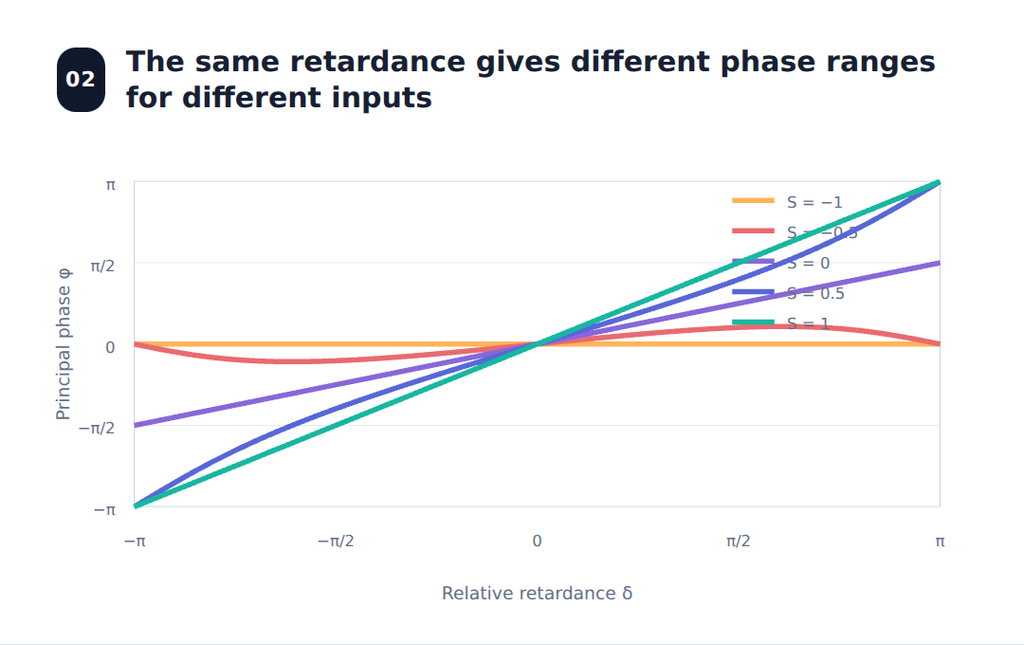
Figure 3. Illustrative phase-coverage curves from the ideal relation. Polarization reachability alone does not guarantee continuous common-phase coverage.
6. Why an orthogonal fourth interaction fixes the problem
The proposed four-interaction sequence is
The first two interactions are orthogonal. Their product is
This factorization exposes two independent roles:
- the sum controls a phase common to both components;
- the difference controls their relative phase and therefore participates in polarization conversion.
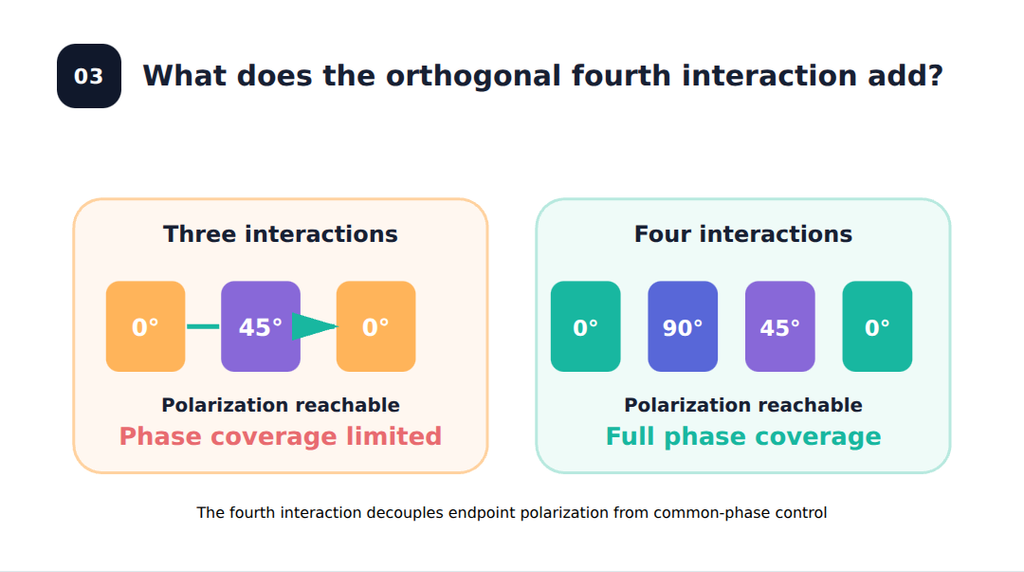
Figure 4. The orthogonal fourth interaction adds complementary common-phase control while preserving polarization reachability.
If the first interaction has little phase authority because the input lies near its unmodulated eigenaxis, the orthogonal interaction acts on the complementary component. The remaining 45° and 0° interactions can then complete the polarization transformation.
For the vertical-polarization counterexample, the 90° interaction can supply the desired phase while the other delays are set to zero.
The paper also identifies (0°), (45°), (0°), (90°) as a valid ordering. It establishes feasible four-interaction architectures; it does not prove that four is the absolute minimum for every possible optical, interferometric, nonlinear, or polarization-independent architecture.
7. A robust numerical test
The ideal model can be tested with Jones propagation and multi-start numerical optimization. A useful loss function separates polarization and phase errors:
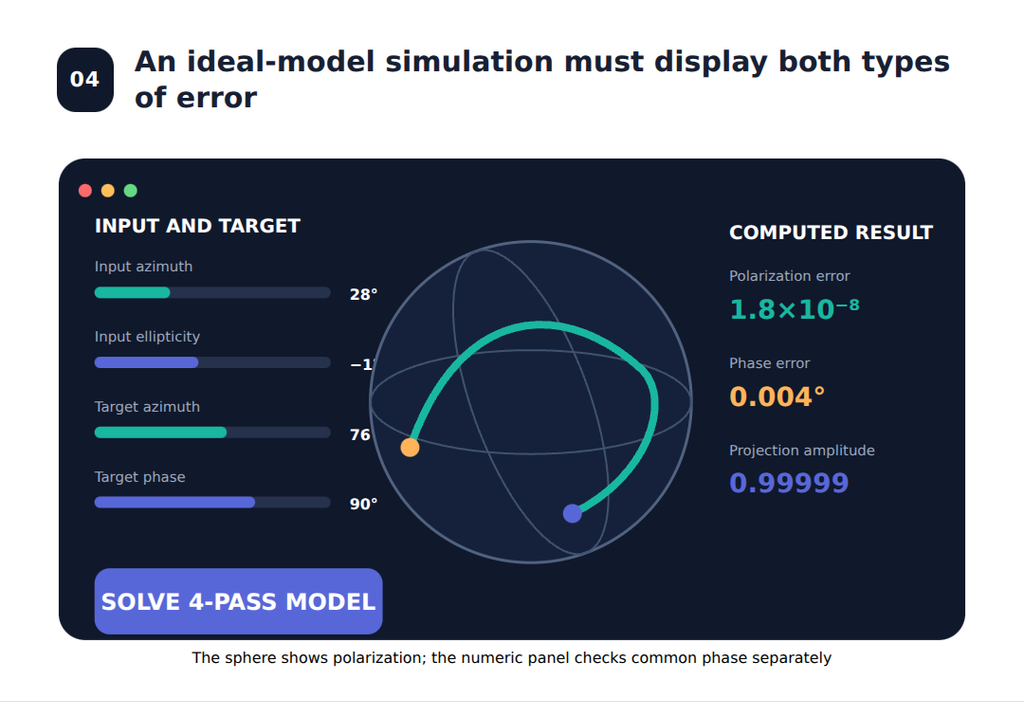
Figure 5. Polarization error and phase error must be reported separately. A correct Poincaré-sphere endpoint is not, by itself, proof of a correct Jones vector.
Here is defined from a nonzero overlap between the calculated field and the target Jones state. Phase is unreliable when that overlap approaches zero.
A defensible workflow is:
- set and verify polarization reachability first;
- reject phase estimates when the relevant complex overlap is nearly zero;
- enable the phase term and solve from multiple initial retardance vectors;
- compare numerical failures with analytical counterexamples or exhaustive phase-range scans.
Failure of one local optimization run is not proof that a target is unreachable.
8. Two, three, and four: the assumptions determine the answer
| Architecture | Input assumption | Guaranteed target in the ideal model |
|---|---|---|
| Two independent retardances | Fixed and known input polarization | Arbitrary fully polarized output state |
| Three interactions, (0°)–(45°)–(0°) | Arbitrary fully polarized input | Arbitrary output polarization, but not arbitrary common phase |
| Four interactions with an orthogonal pair | Arbitrary fully polarized input | Arbitrary output polarization and common phase |
None of these rows implies independent spatial-amplitude control.
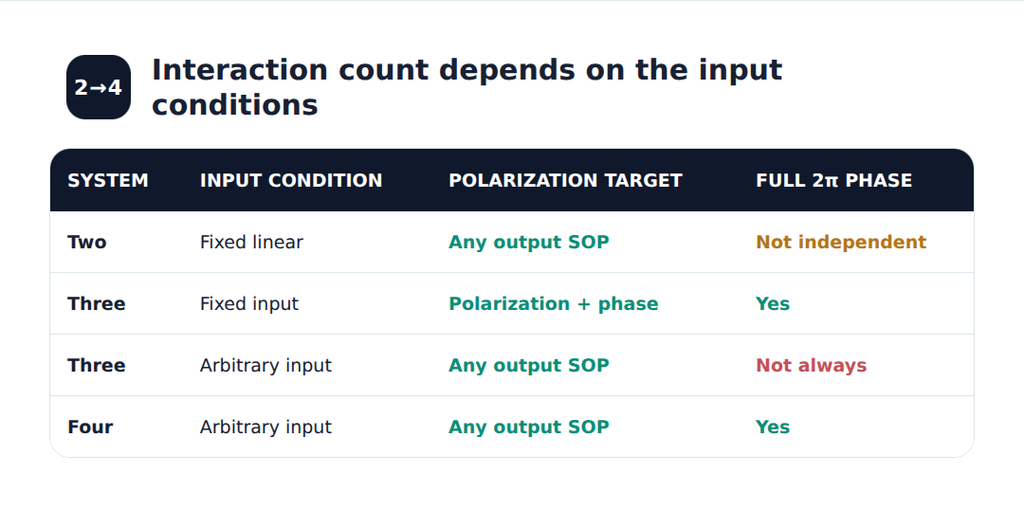
Figure 6. Interaction counts are meaningful only after the input state and required output quantities have been specified.
9. What was innovative about the 2020 work?
It separated endpoint polarization from full Jones-state reachability
The paper shows that reaching the correct point on the Poincaré sphere is not equivalent to reaching the correct Jones vector. The missing common phase must be evaluated explicitly.
It showed why degree counting is insufficient
The retardances are not independent after the endpoint polarization is imposed. A nominally adequate parameter count can still contain a phase blind spot.
It introduced orthogonal phase complementarity
The orthogonal pair ensures that a polarization component ignored by one SLM axis is modulated by the other. This supplies a common-phase degree of freedom without sacrificing the subsequent polarization transformation.
10. What remains an engineering extension?
The following steps are reasonable implementations of the theory, but they are not experimental results reported in the paper:
- construct a reflective multi-pass layout with four accurately conjugated illuminated regions;
- calibrate the lookup table, fixed phase offset, incidence angle, wave-plate errors, registration, and pixel crosstalk for every pass;
- solve the four calibrated transformations jointly rather than using ideal retardances;
- add closed-loop polarimetric and interferometric feedback;
- add amplitude encoding or an interferometric channel when arbitrary complex amplitude is required;
- use a polarization-insensitive phase modulator for the common-wavefront term when the system architecture permits it.
Takeaway
Three SLM interactions can place the output at the correct point on the Poincaré sphere while leaving the omitted common phase incorrect. The fourth, orthogonal interaction is valuable not merely because it adds another parameter, but because it provides complementary phase authority.
The final article explains why different polarization paths between the same endpoints can accumulate different geometric phases—and why that geometric contribution is only one part of the total phase in a multi-SLM system.
References
- Q. Hu, Y. Dai, C. He, and M. J. Booth, “Arbitrary vectorial state conversion using liquid crystal spatial light modulators,” Optics Communications 459, 125028 (2020). https://doi.org/10.1016/j.optcom.2019.125028
- J. C. Gutiérrez-Vega, “Pancharatnam–Berry phase of optical systems,” Optics Letters 36, 1143–1145 (2011). https://doi.org/10.1364/OL.36.001143